Centroid interpolation
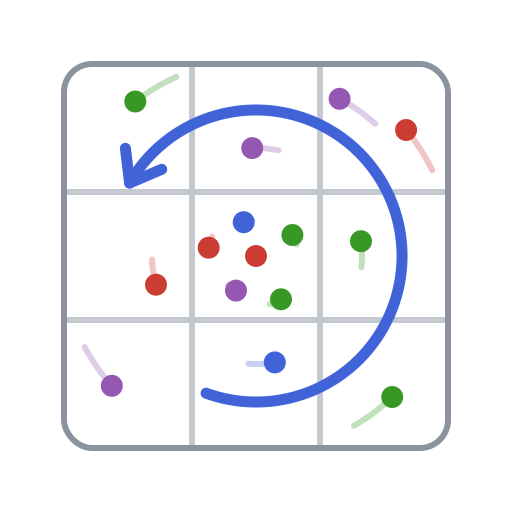
Centroid interpolation transfers a field between cell centers and particles:
centroid grid → particles → centroid gridUse centroid2particle! to interpolate a centroid field to particles and particle2centroid! to accumulate particle values back to centroids.
Ghosted centroid arrays
The stored centroid coordinates particles.xci include ghost centroids. The default centroid-to-particle call uses that layout so particles near a domain boundary still have a complete interpolation stencil:
using JustPIC

xv = range(0, 1, length=9)
yv = range(0, 1, length=9)
dx = step(xv)
dy = step(yv)
xc = range(dx / 2, 1 - dx / 2, length=8)
yc = range(dy / 2, 1 - dy / 2, length=8)
grid_vx = xv, JustPIC.add_periodic_ghost_nodes(yc)
grid_vy = JustPIC.add_periodic_ghost_nodes(xc), yv
particles = init_particles(JustPIC.CPU, 16, 24, 8, grid_vx, grid_vy)

C = [y for x in particles.xci[1], y in particles.xci[2]]
pC, = init_cell_arrays(particles, Val(1))

centroid2particle!(pC, C, particles)
particle2centroid!(C, pC, particles)
particle2centroid! accepts ghost_1, ghost_2, and ghost_3 to control the destination layout, just like particle2grid!.
Physical-only centroid arrays
For a centroid field without ghost values, pass ghosted=false to centroid2particle!. The coordinate range is then taken from the physical centroid coordinates:
C_physical = [y for x in xc, y in yc]

centroid2particle!(pC, C_physical, particles; ghosted=false)

C_out = similar(C_physical)
particle2centroid!(C_out, pC, particles; ghost_1=false, ghost_2=false)
Use the ghosted layout for boundary-sensitive calculations unless the physical only behavior is intentional. Unlike grid2particle!, centroid interpolation uses the ghosted keyword rather than per-direction ghost_i keywords.