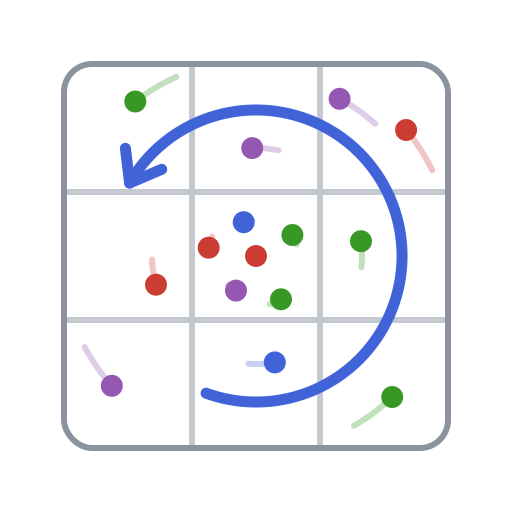
PIC/FLIP temperature update in 2D
The script scripts/temperature_advection_flip.jl carries a temperature blob through a cellular flow and applies a grid-side update (explicit diffusion) to it, once with FLIP and once with PIC. The update is passed to the particles as an increment and brought back to the grid as the average particle increment. See PIC/FLIP for the functions involved.
Particles and the temperature T (at the ghosted centroids) are set up as in Field advection in 2D. Besides the particle temperature pT, a second particle field pT0 stores its value before each update:
particle_args = pT, pT0 = init_cell_arrays(particles, Val(2))
centroid2particle!(pT, T, particles)
Each time step first advects the particles and builds T from them:
advection!(particles, RungeKutta2(), V, dt)
move_particles!(particles, particle_args)
inject_particles!(particles, (pT,))
particle2centroid!(T, pT, particles)
neumann!(T)
particle2centroid! fills only the interior of T. The FLIP transfer below reads the ghost centroids of both T and the updated copy, so their ghost layers must be consistent. Here both use zero-flux copies from the first physical centroid (neumann!).
The three transfers that follow are the whole method:
# 1. grid-side update on a copy of T
Tg .= T
diffuse!(Tg, κ, dt, dx, dy)

# 2. grid → particles: pT += interpolated (Tg - T)   (α = 0: pure FLIP)
pT0.data .= pT.data
centroid2particle_flip!(pT, Tg, T, particles; α)

# 3. particles → grid: T += Σω (pT - pT0) / Σω
particle2centroid_flip!(T, pT, pT0, particles)
After step 3, T equals the grid-side result Tg up to the interpolation error of the two transfers. The script carries two copies of the field on the same particles and flow: a FLIP copy (α = 0) and a PIC copy (α = 1), each with its own particle fields. After 100 steps the FLIP copy still peaks at about 0.75 and stays within 5e-4 of the grid update (relative norm). The PIC copy peaks at about 0.39 and differs from the grid update by about 5e-3: every step replaces the particle values by an average over the grid, which smooths the blob much more than the physical diffusion does. Both rows use the same color scales:
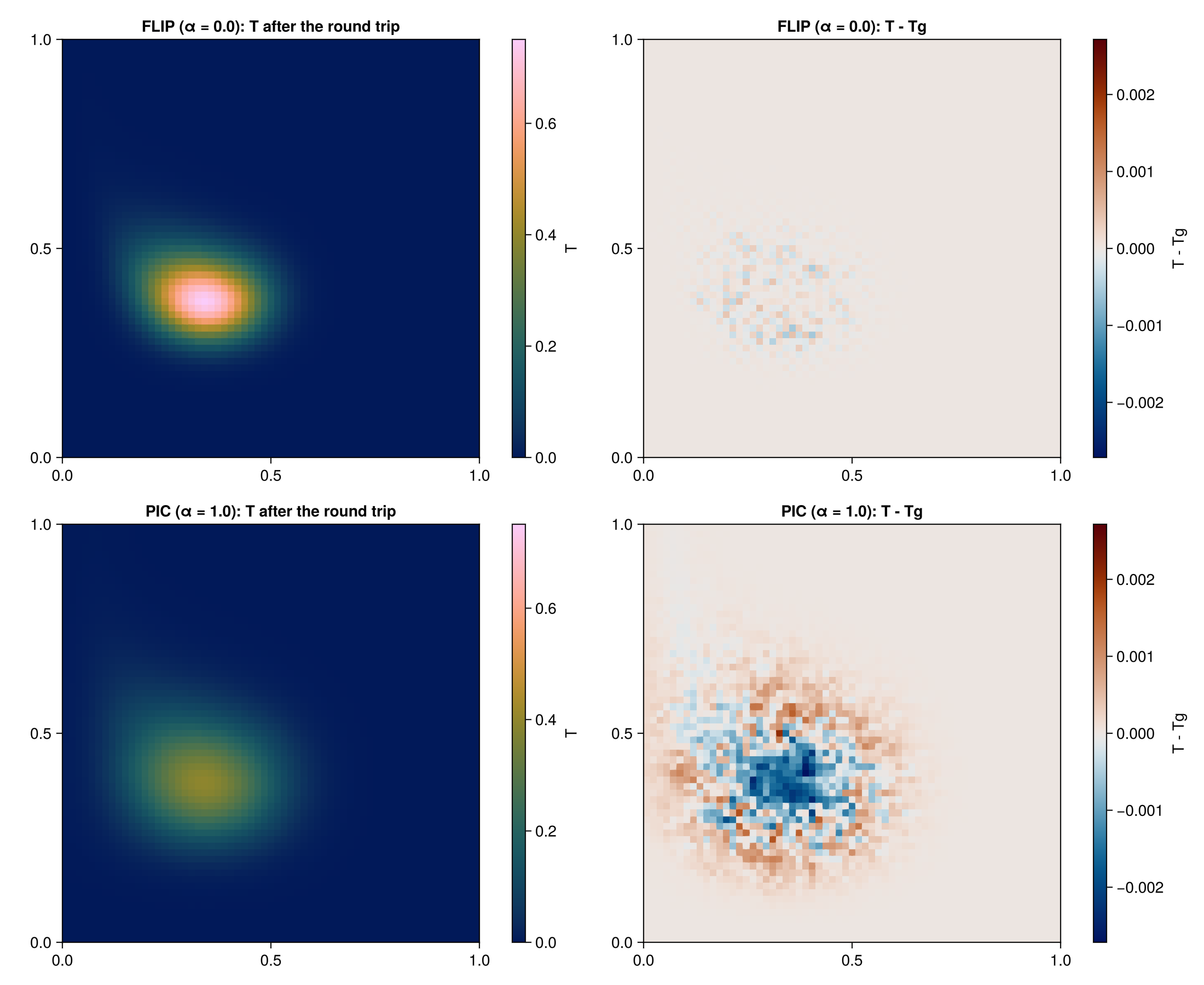
Cells without particles are left untouched by particle2centroid_flip!, and intermediate α blends the two behaviors, damping FLIP noise at the cost of some extra diffusion.
To run the example (it saves figures to figs/):
julia --project=. scripts/temperature_advection_flip.jl