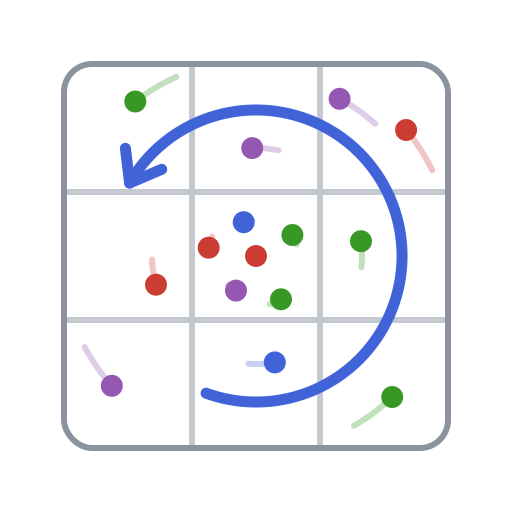
Vertex interpolation
Vertex interpolation transfers a field between grid vertices and particles:
vertex grid → particles → vertex gridUse grid2particle! to interpolate a vertex field to particles and particle2grid! to accumulate particle values back to vertices.
Ghosted vertex arrays
init_particles stores vertex coordinates with one ghost node on each side. The default calls therefore expect the source and destination arrays to use the same ghosted layout:
using JustPIC

xv = range(0, 1, length=9)
yv = range(0, 1, length=9)
dx = step(xv)
dy = step(yv)
xc = range(dx / 2, 1 - dx / 2, length=8)
yc = range(dy / 2, 1 - dy / 2, length=8)
grid_vx = xv, JustPIC.add_periodic_ghost_nodes(yc)
grid_vy = JustPIC.add_periodic_ghost_nodes(xc), yv
particles = init_particles(JustPIC.CPU, 16, 24, 8, grid_vx, grid_vy)

T = [y for x in particles.xvi[1], y in particles.xvi[2]]
pT, = init_cell_arrays(particles, Val(1))

grid2particle!(pT, T, particles)
particle2grid!(T, pT, particles)
For staggered fields, create one coordinate tuple per component. For example, the two-dimensional velocity grids are commonly laid out as (xv, ghosted_yc) and (ghosted_xc, yv); each component can be interpolated with the same two routines.
Physical-only vertex arrays
If a field has no ghost nodes, disable the corresponding shift. The following uses an unghosted field in both directions:
T_physical = [y for x in xv, y in yv]
grid2particle!(pT, T_physical, particles; ghost_1=false, ghost_2=false)

T_out = similar(T_physical)
particle2grid!(T_out, pT, particles; ghost_1=false, ghost_2=false)
Set each ghost_i keyword independently when only some directions are padded. The keywords default to true.
PIC/FLIP update
When both the current and previous vertex fields are available, grid2particle_flip! applies a PIC/FLIP blend. α = 1 is PIC and α = 0 is FLIP:
grid2particle_flip!(pT, T, T_previous, particles; α=0.5)See PIC/FLIP for the particle-to-grid counterpart particle2grid_flip!.