
Magma fragmentation
Fragmentation criteria decide pointwise whether a bubbly magma has broken up into a gas–pyroclast dispersion. Each returns a dimensionless ratio that is at least 1 where the magma is fragmented:
julia> compute_fragmentation(CriticalPorosityFragmentation(), (; ϕ_gas = 0.8))
1.0666666666666667

julia> compute_fragmentation(StrainRateFragmentation(), (; εII = 1.0, η = 1.0e8))
1.1547005383792515
Strain-rate criterion as a yield surface
For a magma with Newtonian viscosity StrainRateFragmentation becomes a von Mises yield stress that does not depend on
The critical strain rate
using GeoParams, CairoMakie
η = 10 .^ range(4, 12, 100)
fig = Figure(size = (800, 500))
ax = Axis(fig[1, 1]; xlabel = "viscosity η (Pa s)", ylabel = "critical strain rate ε̇II (ratio = 1) (s⁻¹)",
    xscale = log10, yscale = log10, xticks = LogTicks(4:2:12))
for G in (3.0e9, 1.0e10, 3.0e10)
    f = StrainRateFragmentation(G = G * Pa)
    τ_y = sqrt(3) * f.k * G
    lines!(ax, η, τ_y ./ (2 .* η); label = "G∞ = $(G / 1e9) GPa, yield stress τII = $(round(τ_y / 1e6; digits = 1)) MPa")
end
axislegend(ax; position = :rt)
fig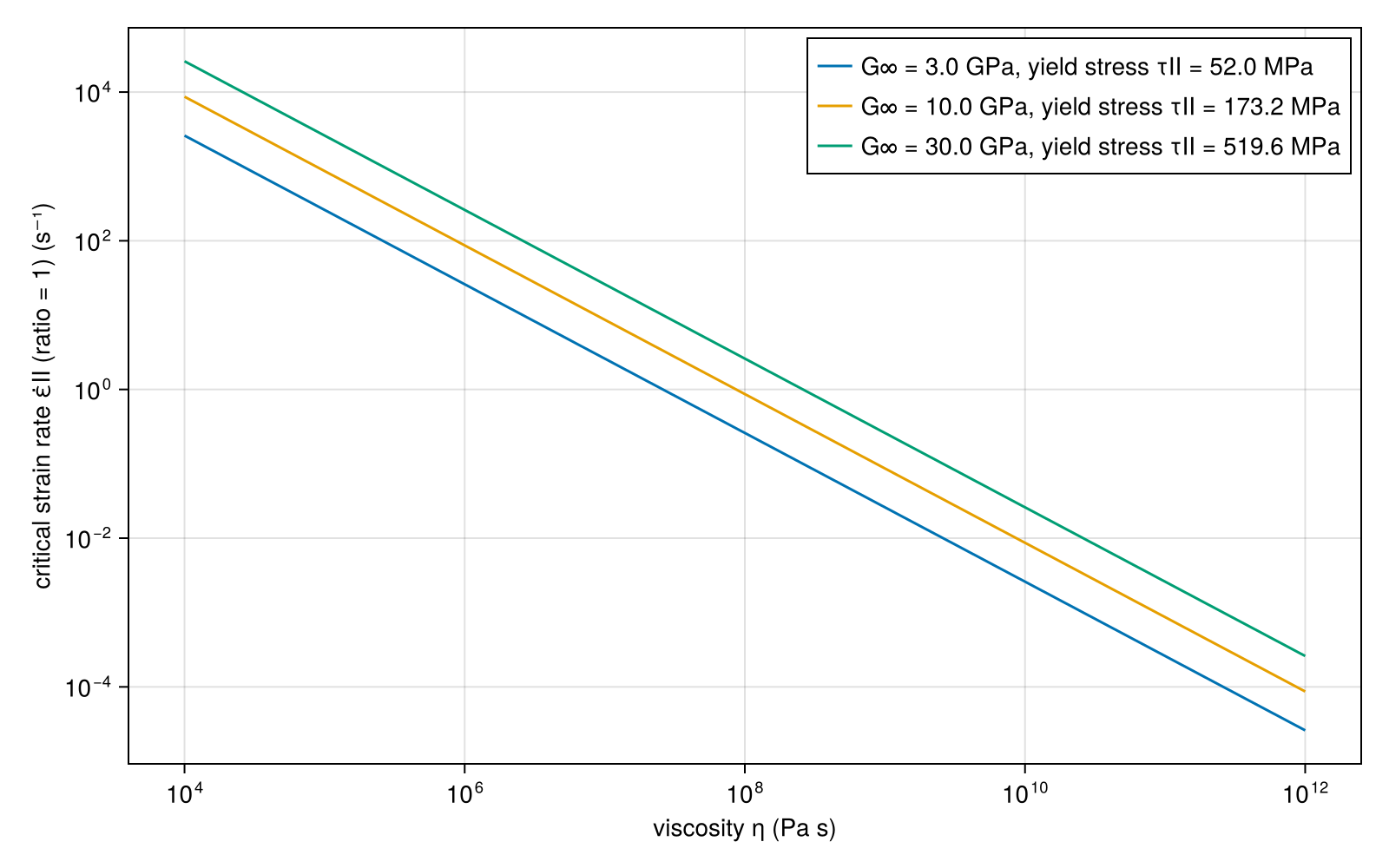
DruckerPrager_regularised(f; η_vp) returns this yield surface. In a viscoelastic CompositeRheology whose elastic modulus is η_vp must be much smaller than the magma viscosity; a value such as η_vp = 1e20Pa*s leaves the stress of a magma practically uncapped.
frag = StrainRateFragmentation(G = 1.0e10Pa)
magma = CompositeRheology(
    LinearViscous(η = 1.0e8Pa * s), ConstantElasticity(G = 1.0e10Pa), DruckerPrager_regularised(frag; η_vp = 1.0e5Pa * s)
)
τ_y = sqrt(3) * frag.k * 1.0e10
args = (; dt = 1.0e3, τII_old = 0.0, P = 0.0)
for εII in (0.01, 1.0, 10.0)
    τII, λ̇ = compute_τII(magma, εII, args)
    println("εII = $εII s⁻¹: τII/τ_y = $(round(τII / τ_y; digits = 3)), λ̇ = $(round(λ̇; sigdigits = 3)) s⁻¹")
end
εII = 0.01 s⁻¹: τII/τ_y = 0.012, λ̇ = 0.0 s⁻¹
εII = 1.0 s⁻¹: τII/τ_y = 1.0, λ̇ = 0.268 s⁻¹
εII = 10.0 s⁻¹: τII/τ_y = 1.011, λ̇ = 18.2 s⁻¹GeoParams.Fragmentation.AbstractFragmentation Type
AbstractFragmentation <: AbstractMaterialParamSupertype of magma fragmentation criteria. compute_fragmentation returns the dimensionless ratio of a criterion's driving quantity to its threshold; the magma is fragmented where this ratio is at least 1. Implemented criteria are CriticalPorosityFragmentation and StrainRateFragmentation.
GeoParams.Fragmentation.CriticalPorosityFragmentation Type
CriticalPorosityFragmentation(; ϕ_crit = 0.75)Fragmentation at a critical gas volume fraction. compute_fragmentation returns
with the gas volume fraction ϕ_gas of the magma as input. Sparks (1978, abstract and p. 28) finds void-to-liquid volume ratios of 3:1 to 5:1 in pumice, i.e. vesicularities of 0.75 to 0.83 just before disruption; the default ϕ_crit = 0.75 is the lower bound, the value Papale (1999, Table 1, p. 426) uses for his critical-porosity runs.
References
Sparks, R. S. J. (1978). The dynamics of bubble formation and growth in magmas: A review and analysis. Journal of Volcanology and Geothermal Research, 3(1–2), 1–37. https://doi.org/10.1016/0377-0273(78)90002-1
Papale, P. (1999). Strain-induced magma fragmentation in explosive eruptions. Nature, 397, 425–428. https://doi.org/10.1038/17109
GeoParams.Fragmentation.StrainRateFragmentation Type
StrainRateFragmentation(; k = 0.01, G = 1e10Pa)Strain-induced fragmentation of Papale (1999, eq. 1, p. 426): magma breaks when its elongational strain rate exceeds a fraction k of the inverse Maxwell relaxation time compute_fragmentation returns
with inputs εII, the second invariant of the deviatoric strain rate, and η, the Newtonian (zero-frequency) shear viscosity of the magma.
Papale states eq. 1 for the elongational strain rate k and G at their pure-melt values; pass the suspension viscosity (e.g. that of a Suspension law) as η to apply eq. 1 as published, or the melt viscosity to use the melt relaxation time of Gonnermann (2015, sect. 3). k. In the compressible one-dimensional flow of Papale's conduit model,
Papale (1999, p. 426) gives G is the unrelaxed shear modulus G = 1e10Pa is the composition-independent estimate G must carry stress units, so that nondimensionalize scales it like η and εII.
References
Papale, P. (1999). Strain-induced magma fragmentation in explosive eruptions. Nature, 397, 425–428. https://doi.org/10.1038/17109
Dingwell, D. B., & Webb, S. L. (1989). Structural relaxation in silicate melts and non-Newtonian melt rheology in geologic processes. Physics and Chemistry of Minerals, 16, 508–516. https://doi.org/10.1007/BF00197020
Gonnermann, H. M. (2015). Magma fragmentation. Annual Review of Earth and Planetary Sciences, 43, 431–458. https://doi.org/10.1146/annurev-earth-060614-105206
GeoParams.Fragmentation.compute_fragmentation Function
compute_fragmentation(f::AbstractFragmentation, args)Fragmentation ratio of criterion f at a point, with the inputs of f passed in the NamedTuple args; entries that f does not use are ignored. The magma is fragmented where the ratio is at least 1. The keyword form f(; args...) is equivalent. The ratio is dimensionless and therefore the same for dimensional and nondimensionalized inputs.
GeoParams.MaterialParameters.ConstitutiveRelationships.DruckerPrager_regularised Method
DruckerPrager_regularised(f::StrainRateFragmentation; η_vp)Yield surface equivalent to the strain-rate criterion f: with ϕ = 0, Ψ = 0 and cohesion C η_vp regularizes the localization of the failure; it must be small compared with the magma viscosity, or the stress overshoots the yield stress. Build it from a dimensional f and nondimensionalize the result.