Magma suspensions
Suspension wraps the creep law of a melt and multiplies its viscosity by the relative viscosities ϕ_x and ϕ_gas:
using GeoParams, CairoMakie
law = Suspension(LinearViscous(η = 1.0e3Pa * s); crystals = Roscoe1952_Crystals(), bubbles = IshiiZuber1979_Bubbles())
compute_relative_viscosity(law; ϕ_x = 0.3, ϕ_gas = 0.1)4.272227540300969Rigid crystals and undeformable bubbles
Roscoe1952_Crystals describes rigid particles that lock up at the maximum packing fraction IshiiZuber1979_Bubbles describes bubbles that stay spherical. The figure compares Roscoe's (1952) parameters for equal spheres, the Krieger–Dougherty form fitted to crystal-bearing basalt by Keller & Suckale (2019), and Ishii–Zuber bubbles as a function of their volume fraction.
ϕ = range(0, 0.74, 300)
fig = Figure(size = (800, 500))
ax = Axis(fig[1, 1]; xlabel = "crystal or gas volume fraction ϕ (–)", ylabel = "relative viscosity ηᵣ (–)", yscale = log10)
lines!(ax, ϕ, compute_relative_viscosity.(Ref(Roscoe1952_Crystals()), ϕ); label = "Roscoe1952_Crystals(), Roscoe (1952)")
lines!(ax, ϕ, compute_relative_viscosity.(Ref(Roscoe1952_Crystals(ϕ_max = 0.58, n = 2.32)), ϕ);
    label = "Roscoe1952_Crystals(ϕ_max = 0.58, n = 2.32), Keller & Suckale (2019)")
lines!(ax, ϕ, compute_relative_viscosity.(Ref(IshiiZuber1979_Bubbles()), ϕ); label = "IshiiZuber1979_Bubbles() (bubbles)")
ylims!(ax, 1, 1.0e4)
axislegend(ax; position = :lt)
fig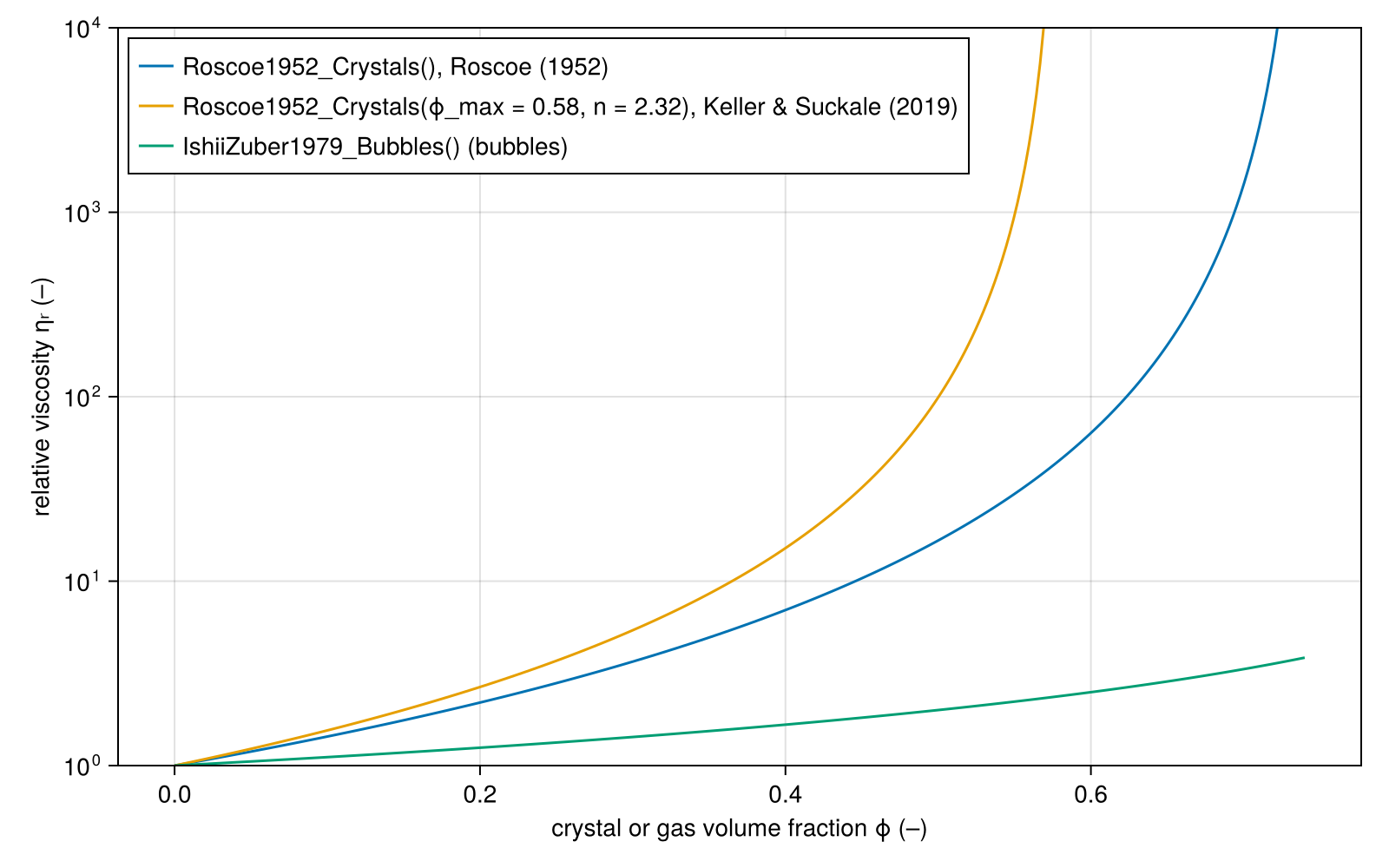
GeoParams.MaterialParameters.ConstitutiveRelationships.Suspension Type
Suspension(law; crystals = nothing, bubbles = nothing)Creep law law of the melt, stiffened by suspended crystals and bubbles. As in the three-phase model of Truby et al. (2015, eq. 3.2), the crystals are suspended in the bubbly melt:
where IshiiZuber1979_Bubbles) up to crystals and bubbles are relative viscosities such as Roscoe1952_Crystals, Mueller2010_Crystals and IshiiZuber1979_Bubbles; nothing means no effect.
The relative viscosities may also depend on the strain rate Vona2011_Crystals depend on its shear rate Mader2013_Bubbles depend on the capillary number, which the stress of the melt sets at the strain rate compute_τII stays explicit, and compute_εII solves for NaN if it does not converge. At high gas fractions the stress of capillary bubble laws can decrease with strain rate, so the strain rate at a given stress need not be unique.
The crystal and gas volume fractions of the whole suspension are passed at runtime as ϕ_x and ϕ_gas, the same keywords that ThreePhase_Density uses, e.g. compute_εII(law, τII; T, ϕ_x = 0.3, ϕ_gas = 0.1). Both are required. All keyword arguments are also passed on to law.
Example
julia> law = Suspension(LinearViscous(η = 1e5Pa*s); crystals = Roscoe1952_Crystals(ϕ_max = 1), bubbles = IshiiZuber1979_Bubbles());

julia> compute_τII(law, 1.0; ϕ_x = 0.2, ϕ_gas = 0.5) / compute_τII(law.law, 1.0)
4.658474953124561
References
Chateau, X., Ovarlez, G., & Trung, K. L. (2008). Homogenization approach to the behavior of suspensions of noncolloidal particles in yield stress fluids. Journal of Rheology, 52(2), 489–506. https://doi.org/10.1122/1.2838254
Truby, J. M., Mueller, S. P., Llewellin, E. W., & Mader, H. M. (2015). The rheology of three-phase suspensions at low bubble capillary number. Proceedings of the Royal Society A, 471(2173), 20140557. https://doi.org/10.1098/rspa.2014.0557
GeoParams.MaterialParameters.ConstitutiveRelationships.Roscoe1952_Crystals Type
Roscoe1952_Crystals(; ϕ_max = 1/1.35, n = 2.5)Einstein–Roscoe relative viscosity of a suspension of rigid spheres,
with NaN outside
References
Roscoe, R. (1952). The viscosity of suspensions of rigid spheres. British Journal of Applied Physics, 3(8), 267–269. https://doi.org/10.1088/0508-3443/3/8/306
Krieger, I. M., & Dougherty, T. J. (1959). A mechanism for non-Newtonian flow in suspensions of rigid spheres. Transactions of the Society of Rheology, 3, 137–152. https://doi.org/10.1122/1.548848
Keller, T., & Suckale, J. (2019). A continuum model of multi-phase reactive transport in igneous systems. Geophysical Journal International, 219(1), 185–222. https://doi.org/10.1093/gji/ggz287
GeoParams.MaterialParameters.ConstitutiveRelationships.IshiiZuber1979_Bubbles Type
IshiiZuber1979_Bubbles()Ishii–Zuber relative viscosity of a suspension of undeformable spherical bubbles (capillary number
with NaN outside
References
- Ishii, M., & Zuber, N. (1979). Drag coefficient and relative velocity in bubbly, droplet or particulate flows. AIChE Journal, 25(5), 843–855. https://doi.org/10.1002/aic.690250513
GeoParams.MaterialParameters.ConstitutiveRelationships.compute_relative_viscosity Function
compute_relative_viscosity(f::AbstractRateDependentViscosity, ϕ, x)Relative viscosity of the law f at volume fraction ϕ and rate x: the capillary number for bubble laws such as Mader2013_Bubbles, and the shear rate Vona2011_Crystals.
Example
julia> compute_relative_viscosity(Mader2013_Bubbles(), 0.5, 0.0)
2.0compute_relative_viscosity(f::AbstractRelativeViscosity, ϕ)
compute_relative_viscosity(a::Suspension; ϕ_x, ϕ_gas)
compute_relative_viscosity(a::Suspension, args)Relative viscosity f at volume fraction ϕ, or of the suspension a, which is args is a NamedTuple that must contain ϕ_x and ϕ_gas; its other entries are ignored.
Example
julia> compute_relative_viscosity(IshiiZuber1979_Bubbles(), 0.5)
2.0Particle shape, shear rate and bubble deformation
The laws of this section account for the shape of crystals and for the dependence of
Elongated crystals
Mueller2010_Crystals lowers the maximum packing fraction with the particle aspect ratio
using GeoParams, CairoMakie
ϕ_x = range(0, 0.74, 300)
fig = Figure(size = (800, 500))
ax = Axis(fig[1, 1]; xlabel = "crystal volume fraction ϕₓ (–)", ylabel = "relative viscosity ηᵣ (–)", yscale = log10)
for r_p in (1, 5, 10)
    lines!(ax, ϕ_x, compute_relative_viscosity.(Ref(Mueller2010_Crystals(aspect_ratio = r_p)), ϕ_x); label = "Mueller2010_Crystals, rₚ = $r_p")
end
lines!(ax, ϕ_x, compute_relative_viscosity.(Ref(Roscoe1952_Crystals()), ϕ_x); color = :black, linestyle = :dash,
    label = "Roscoe1952_Crystals(), Roscoe (1952)")
ylims!(ax, 1, 1.0e4)
axislegend(ax; position = :lt)
fig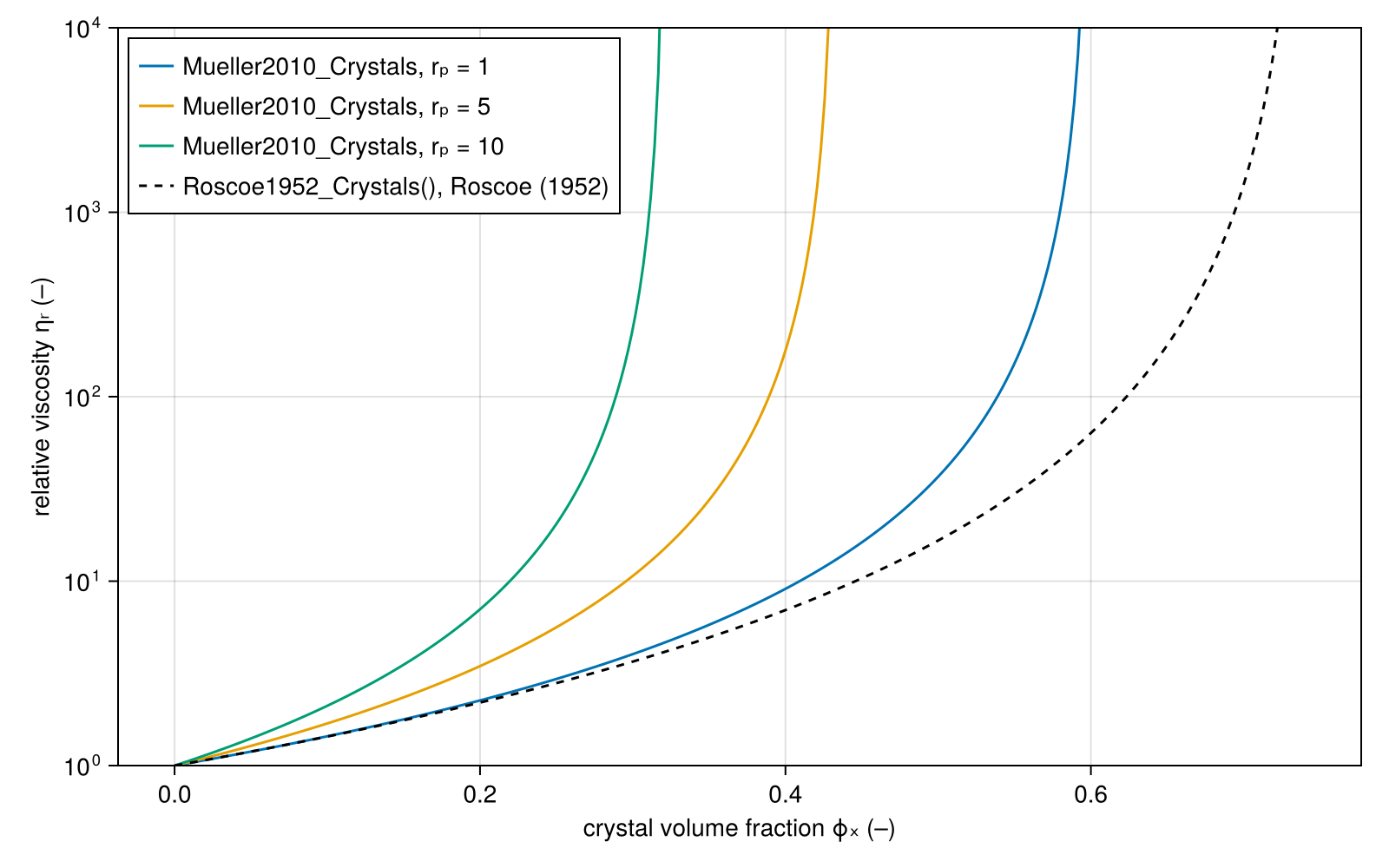
Shear-thinning crystal suspensions
Vona2011_Crystals makes the Maron–Pierce law of Mueller2010_Crystals shear thinning:
ϕ_x = range(0, 0.35, 300)
f = Vona2011_Crystals()
η_r(ϕ, γ̇) = compute_relative_viscosity(f, ϕ, γ̇)
fig = Figure(size = (800, 500))
ax = Axis(fig[1, 1]; xlabel = "crystal volume fraction ϕₓ (–)", ylabel = "ηᵣ(γ̇) / ηᵣ(1 s⁻¹) (–)")
vspan!(ax, 0.07, 0.27; color = (:gray, 0.2), label = "calibrated range of ϕₓ")
hlines!(ax, 1; color = :black, linestyle = :dash, label = "γ̇ = 1 s⁻¹ (Mueller2010_Crystals, rₚ = 6.5)")
for γ̇ in (0.02, 0.2, 2.0)
    lines!(ax, ϕ_x, η_r.(ϕ_x, γ̇) ./ η_r.(ϕ_x, 1.0); label = "Vona2011_Crystals(), γ̇ = $γ̇ s⁻¹")
end
xlims!(ax, 0, 0.35)
axislegend(ax; position = :lt)
fig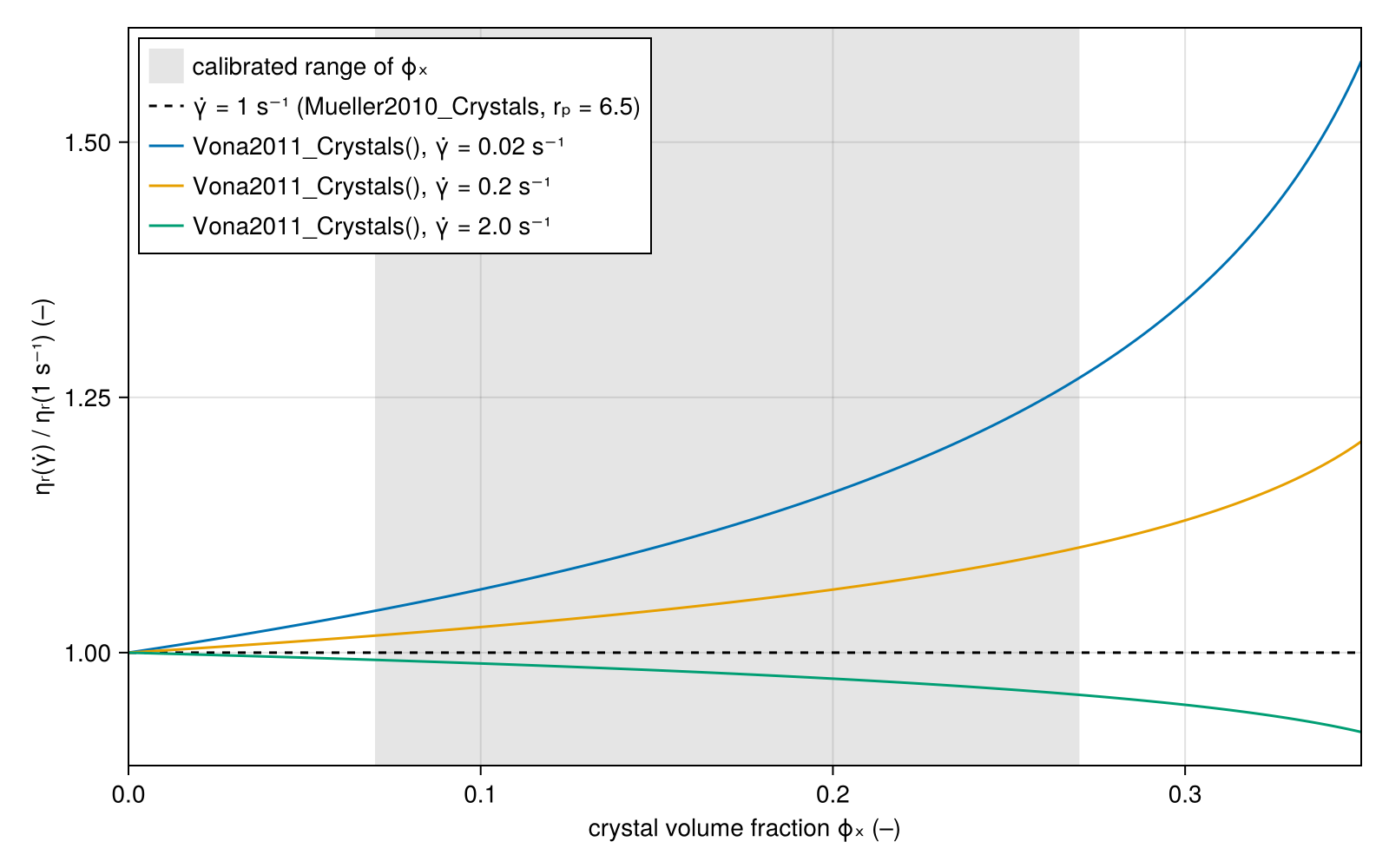
Deformable bubbles
Bubbles stiffen the melt while surface tension keeps them spherical and weaken it once the flow stretches them. Mader2013_Bubbles interpolates between the two limits as a function of the capillary number AbstractCapillaryViscosity): IshiiZuber1979_Bubbles, for
f = Mader2013_Bubbles()
Ca = 10 .^ range(-2, 2, 300)
fig = Figure(size = (800, 500))
ax = Axis(fig[1, 1]; xlabel = "capillary number Ca (–)", ylabel = "relative viscosity ηᵣ (–)", xscale = log10)
ϕ_gas = (0.1, 0.3, 0.5)
colors = Makie.wong_colors()[1:3]
for (ϕ, color) in zip(ϕ_gas, colors)
    lines!(ax, Ca, compute_relative_viscosity.(Ref(f), ϕ, Ca); color)
    hlines!(ax, compute_relative_viscosity(IshiiZuber1979_Bubbles(), ϕ); color, linestyle = :dash)
    hlines!(ax, (1 - ϕ)^(5 / 3); color, linestyle = :dot)
end
elements = [[LineElement(; color) for color in colors]; LineElement(color = :black, linestyle = :dash);
    LineElement(color = :black, linestyle = :dot)]
labels = [["Mader2013_Bubbles(), ϕ_gas = $ϕ" for ϕ in ϕ_gas]; "Ca → 0: (1 − ϕ)⁻¹ (IshiiZuber1979_Bubbles)"; "Ca → ∞: (1 − ϕ)^(5/3)"]
axislegend(ax, elements, labels; position = :rt)
fig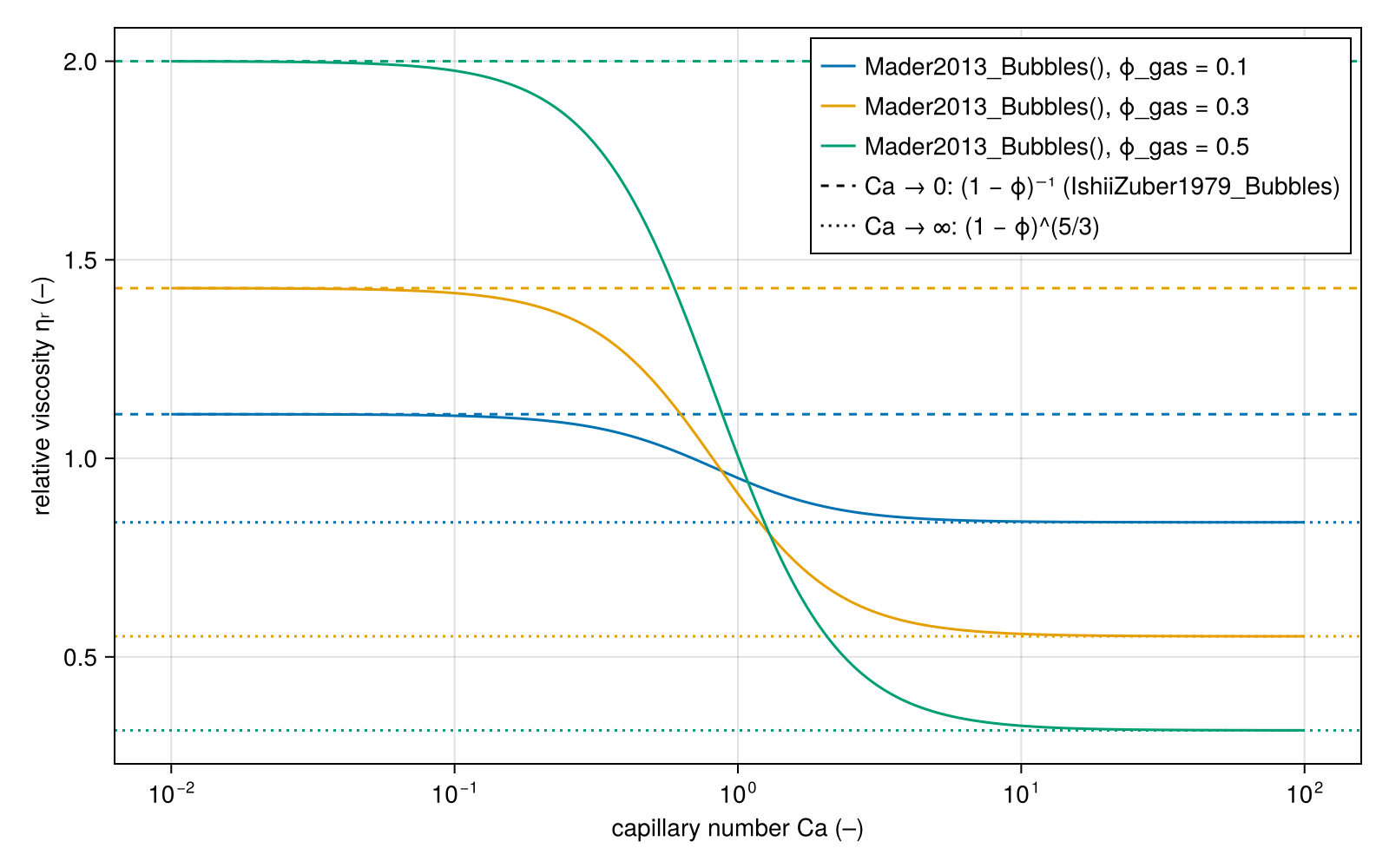
Stress decreasing with strain rate
For a Newtonian melt, the capillary number is proportional to the strain rate, so the stress of the suspension is proportional to
The threshold can be checked numerically:
stress_decreases(ϕ_gas) = any(diff(compute_relative_viscosity.(Ref(Mader2013_Bubbles()), ϕ_gas, Ca) .* Ca) .< 0)
stress_decreases(0.55), stress_decreases(0.57)
(false, true)Three-phase suspensions
Following Truby et al. (2015), Suspension suspends the crystals in the bubbly melt, whose gas fraction is
law = Suspension(LinearViscous(); crystals = Mueller2010_Crystals(aspect_ratio = 1), bubbles = IshiiZuber1979_Bubbles())
ϕ_x = range(0, 0.5, 300)
fig = Figure(size = (800, 500))
ax = Axis(fig[1, 1]; xlabel = "crystal volume fraction ϕₓ (–)", ylabel = "relative viscosity ηᵣ (–)", yscale = log10)
for ϕ_gas in (0.0, 0.05, 0.1, 0.15)
    lines!(ax, ϕ_x, [compute_relative_viscosity(law; ϕ_x = x, ϕ_gas) for x in ϕ_x]; label = "ϕ_gas = $ϕ_gas")
end
axislegend(ax; position = :lt)
fig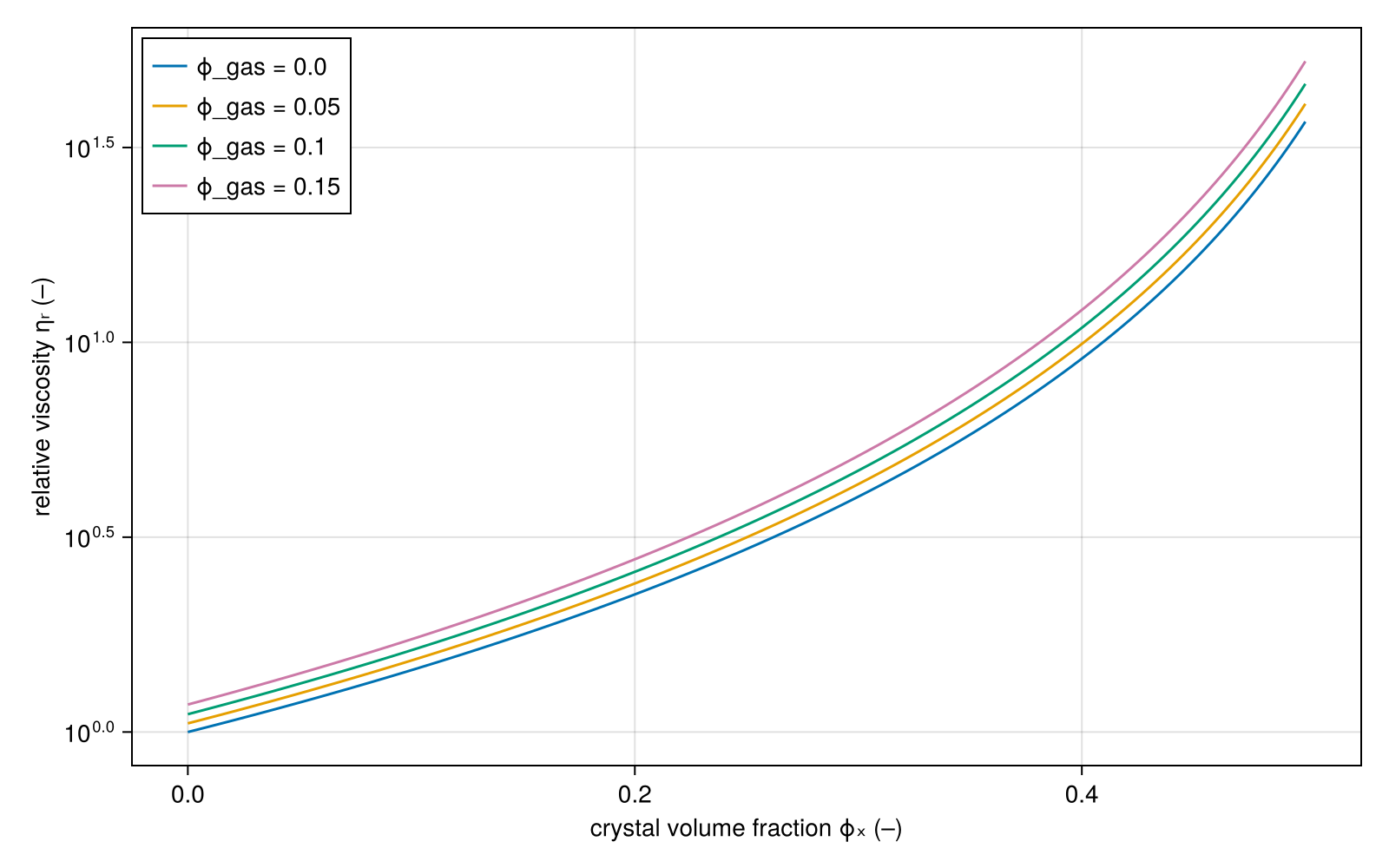
GeoParams.MaterialParameters.ConstitutiveRelationships.Mueller2010_Crystals Function
Mueller2010_Crystals(; aspect_ratio)Maron–Pierce relative viscosity of a suspension of particles with aspect ratio aspect_ratio, after Mueller et al. (2010, eqs 2.4 and 5.1),
returned as the equivalent Roscoe1952_Crystals law with
References
- Mueller, S., Llewellin, E. W., & Mader, H. M. (2010). The rheology of suspensions of solid particles. Proceedings of the Royal Society A, 466(2116), 1201–1228. https://doi.org/10.1098/rspa.2009.0445
GeoParams.MaterialParameters.ConstitutiveRelationships.Vona2011_Crystals Type
Vona2011_Crystals(; aspect_ratio = 6.5, a = 0.06)Shear-thinning relative viscosity of crystal-bearing basalt after Vona et al. (2011, eq. 23),
with crystal volume fraction Mueller2010_Crystals for crystals of mean aspect ratio aspect_ratio, as Vona et al. (2011, eq. 6) compute it. Equivalently, the suspension is a power-law fluid, Suspension it is the shear rate of the whole suspension. The default aspect ratio is the representative value of their Fig. 10b. NaN outside
Example
julia> compute_relative_viscosity(Vona2011_Crystals(aspect_ratio = 7.25), 0.272, 0.02)
17.515418342481468
References
- Vona, A., Romano, C., Dingwell, D. B., & Giordano, D. (2011). The rheology of crystal-bearing basaltic magmas from Stromboli and Etna. Geochimica et Cosmochimica Acta, 75(11), 3214–3236. https://doi.org/10.1016/j.gca.2011.03.031
GeoParams.MaterialParameters.ConstitutiveRelationships.AbstractCapillaryViscosity Type
AbstractCapillaryViscosityRelative viscosity
with bubble radius
GeoParams.MaterialParameters.ConstitutiveRelationships.Mader2013_Bubbles Type
Mader2013_Bubbles(; r = 1e-4m, Γ = 0.3J/m^2)Relative viscosity of a suspension of deformable bubbles in steady flow, the Cross model of Mader et al. (2013, eqs 27–29),
with gas volume fraction r and surface tension Γ. AbstractCapillaryViscosity. Undeformed bubbles (IshiiZuber1979_Bubbles; fully deformed bubbles (NaN outside
The default Γ = 0.3 N/m is the value of the worked example of Mader et al. (2013, §7.3.1, p. 155), the upper end of the range 0.05–0.3 N/m they give for hydrous to anhydrous silicate melts (§3.1, p. 137). The default bubble radius r = 0.1 mm is a placeholder; set it for each application.
References
Mader, H. M., Llewellin, E. W., & Mueller, S. P. (2013). The rheology of two-phase magmas: A review and analysis. Journal of Volcanology and Geothermal Research, 257, 135–158. https://doi.org/10.1016/j.jvolgeores.2013.02.014
Llewellin, E. W., Mader, H. M., & Wilson, S. D. R. (2002). The constitutive equation and flow dynamics of bubbly magmas. Geophysical Research Letters, 29(24), 2170. https://doi.org/10.1029/2002GL015697
Llewellin, E. W., & Manga, M. (2005). Bubble suspension rheology and implications for conduit flow. Journal of Volcanology and Geothermal Research, 143(1–3), 205–217. https://doi.org/10.1016/j.jvolgeores.2004.09.018